
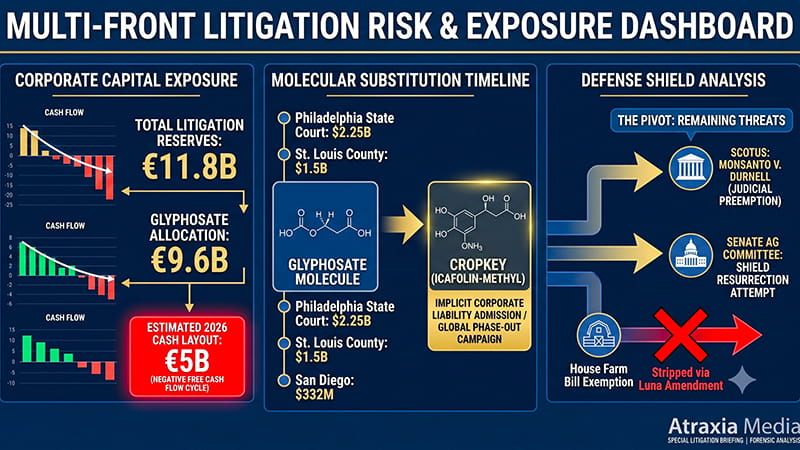
The financial consequences of state court judgments are causing Bayer AG to shift its defense strategy from federal preemption.
Several events are expected to come together in June 2026 that will change glyphosate litigation liability in tens of thousands of current cases.
Plaintiff counsel need to act now by auditing their inventories and adjusting litigation strategy before these structural changes reshape the liability framework.
Supreme Court ruling expected in late June
The Supreme Court will issue a dispositive preemption ruling in Monsanto Co. v. Durnell before the current term concludes. The case centers on whether the Federal Insecticide, Fungicide, and Rodenticide Act completely bars state-law failure-to-warn claims. Bayer argues that because the EPA approved its uniform label without a carcinogen warning, state courts lack authority to impose stricter warning mandates.
The Court accepted certiorari to resolve a profound division among federal circuits. The Third Circuit's Schaffner v. Monsanto decision created a direct split with anti-preemption rules in the Ninth Circuit, Eleventh Circuit, and Missouri Court of Appeals. An adverse ruling will eliminate failure-to-warn claims in thousands of pending cases, forcing plaintiff counsel to pivot away from pure labeling arguments and rely instead on design defect and consumer fraud theories.
Jury verdicts demonstrate sustained hostility toward Monsanto
Bayer's public relations messaging suggests the litigation is stabilizing, but what's actually happening in state courtrooms tells a different story. Juries continue to punish Monsanto's history of internal scientific concealment, as three recent verdicts show:
- Pennsylvania: A Philadelphia jury awarded $250 million in compensatory damages and $2 billion in punitive damages to a non-Hodgkin lymphoma plaintiff with decades of exposure.
- California: San Diego trial resulted in a $332 million verdict with over $300 million in punitive damages, confirming West Coast juries reject defense epidemiological narratives.
- Missouri: St. Louis County jury rendered a combined multi-plaintiff judgment totaling $1.5 billion in Monsanto's historic corporate backyard.
These verdicts show that juries don't hold back on punitive damages when they see evidence of internal concealment. With verdicts running 10 to 100 times higher than settlement offers, there's still significant leverage available for plaintiffs in pending cases.
Bayer's financials are under pressure due to a settlement
Bayer revised its global financial filings on Feb. 17, 2026, increasing the total amount set aside for litigation liabilities to 11.8 billion euros. Of that, 9.6 billion euros are set aside specifically for glyphosate claims. Corporate filings project cash outlays of around 5 billion euros in 2026 alone, pushing the company into negative free cash flow.
The financial pressure Bayer is under reveals a clear defense strategy: use expanded reserves to push through confidential block settlements before a Supreme Court ruling changes how cases are valued. The goal is to clear high-risk state court dockets before late June. In active mediation, plaintiff counsel should use this cash flow pressure to their benefit by pushing for maximum value while the defense has already budgeted for these payouts.
Product substitution signals internal admissions
Bayer's push to replace glyphosate with a new compound looks a lot like an internal acknowledgment of liability exposure. The company has filed for regulatory approval of a product called CropKey across the US, EU, Brazil, and Canada. The new formula sidesteps the glyphosate molecule entirely, substituting an alternative active ingredient called icafolin-methyl.
This strategy serves as an implicit corporate admission during discovery. Bayer is spending millions to phase out glyphosate while publicly proclaiming its absolute safety. Plaintiff counsel should force corporate representatives during depositions to explain why the parent company pursues product substitution if the original formulation poses no health risks.
Legislative maneuvering fails to create a liability shield
Bayer's $12.2 million federal lobbying push recently fractured on Capitol Hill. Although the House passed the 2026 Farm Bill on April 30, 2026, a populist bipartisan coalition passed the Luna Amendment, stripping the defense's preferred pesticide liability shield from the final text. Defense interests now pressure the Senate Agriculture Committee to resurrect preemption language during upcoming markups.
At the same time, Bayer is attempting to use a February 2026 Executive Order under the Defense Production Act to rebrand glyphosate as a critical national defense asset, effectively shielding it from civil tort liability under the cover of national security. The move is a sign of how desperate the company has become as its legislative efforts unravel.
Atraxia Media monitors litigation inflection points
Keeping up with Supreme Court developments, verdict trends, and corporate financial positioning is what separates good settlement leverage from great settlement leverage. Atraxia Media continuously tracks the glyphosate litigation landscape and the inflection points that shift how cases are valued and how much exposure remains.
Our forensic litigation intelligence identifies strategic opportunities in active dockets before defense counsel restructures liability frameworks. If you represent glyphosate exposure victims, contact us to find out how we help firms leverage corporate financial pressure, jury sentiment, and product substitution admissions at the settlement table.