
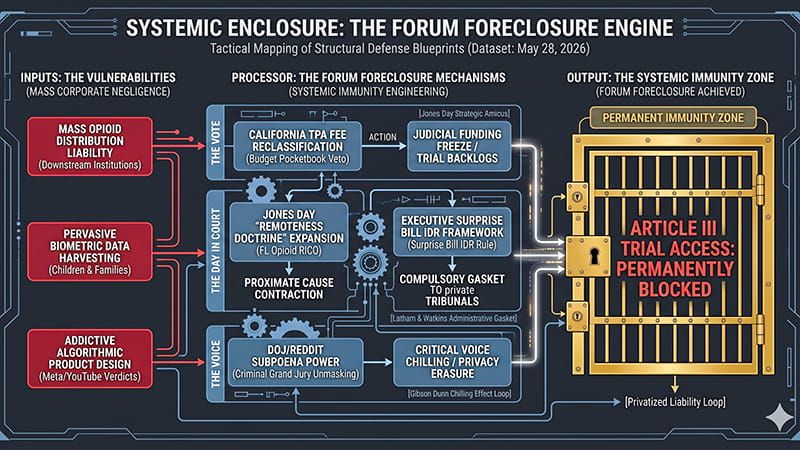
Corporate interest groups are implementing a coordinated legal architecture designed to systematically strip ordinary Americans of their right to a jury trial. The isolated arbitration fights, ballot measure campaigns, or court decisions are, in fact, interlocking gears in one machine.
The forum foreclosure strategy unfolds in three distinct tracks: limiting access to voting through ballot measures, silencing public voice and whistleblower anonymity, and neutering the viability of jury trials. White-shoe defense firms with coordinated political networks are rolling out a centralized playbook to move corporate liability out of the reach of common law scrutiny.
Plaintiff firms that treat these developments as isolated industry problems miss the macro-litigation landscape reshaping civil justice access.
California as the corporate testing ground
California serves as the primary laboratory for corporate-funded initiatives designed to isolate consumers from legal representation. Uber-backed contingency fee restrictions propose placing artificial 25% caps on consumer attorney fees, including all expert witness fees, medical liens, and active litigation costs. In catastrophic injury cases, expert mapping and deposition costs routinely exhaust the entire 25% threshold before any attorney compensation occurs. The structure makes cases financially impossible for plaintiff firms, which have to lay out costs with no assurance of reimbursement.
The Taxpayer Protection Act treats court filing fees and administrative adjustments as taxes, requiring supermajority approval to pass. This locks court budgets in place and limits how funding can be adjusted, producing understaffing, deteriorating technology, and trial backlogs that compound over time. Routine budget adjustments become politically impossible without a broad consensus, and the practical result is that corporate interests can manufacture a resource crisis inside the courts, turning the right to a trial into something that's nearly impossible to exercise.
Recent judicial rulings expand the foreclosure strategy
Recent court decisions reinforce forum foreclosure through narrower liability interpretations and the displacement of disputes into private systems.
- Florida opioid RICO dismissal: State courts found that indirect economic injuries to medical institutions are not a legal basis for filing negligence or RICO claims against retail pharmacy chains. By severely limiting the definition of direct victims, courts entirely insulated distribution chains from downstream public health costs of corporate negligence.
- Administrative privatization: Executive agencies establish explicit limits on Independent Dispute Resolution systems for health care billing disputes. This framework explicitly isolates disputes from Article III judicial oversight, cementing compulsory closed-loop systems controlled entirely by executive guidelines rather than standard civil discovery or common law evidentiary rules.
- Grand jury unmasking: Federal prosecutors used grand jury powers to demand unredacted identity, location tracking, and banking information of anonymous social media users. Allegedly aimed at critics, this move cuts to the heart of the boundaries of anonymous speech protected under the First Amendment, creating chilling effects so profound that they destroy the public's ability to safely blow the whistle on institutional abuse.
Tactical architecture across jurisdictions
Forum foreclosure operates through interconnected components across multiple jurisdictions. Each tactic targets a different access point to civil justice, yet all serve the same objective: moving corporate liability outside common law boundaries.
The "Day in Court" pillar cripples jury trials with fee caps and budget starvation, making them financially impossible. The "Vote" pillar threatens ballot campaigns with deceptive signature collection that exploits vulnerable populations such as low-income seniors. The "Voice" pillar exposes anonymous critics and weaponizes grand jury subpoenas to dismantle digital privacy protections, targeting whistleblowers.
These strategies seem disparate but meld perfectly. A plaintiff firm with 25% fee caps cannot afford complex litigation that defense firms spend unlimited resources defending. Understaffed courts with multi-year backlogs make even viable claims economically unviable. Whistleblowers facing unmasking will not expose misconduct that lawyers could discover through discovery. No single measure closes courtrooms, but together they render the entire system unusable for ordinary citizens.
Counter-strategy for plaintiff advocates
Plaintiff bar leadership must recognize these systemic shifts and frame responses around defending the separation of powers. Corporate strategies seek to place commercial behavior entirely outside the boundary of common law. When advocates speak to bar associations and regional leaders, they should emphasize that corporate litigation strategies are not simply legal disputes, but are, in essence, assaults on constitutional structure.
Law firms must coordinate defenses across state lines to prevent corporate strategies from being exported once successful in California. The playbook used in California will be cloned for other high-stakes jurisdictions if not defeated. Recognizing the macro-diagnostic pattern allows the plaintiff bar to mount unified resistance rather than fighting isolated battles.
Atraxia Media navigates the changing industry
Most marketing entities treat case acquisition as isolated market opportunities without analyzing structural conditions determining viability. Atraxia Media invests in structural litigation data and macro-diagnostic analysis, identifying sustainable practice areas within the changing legal environment. Our distinct advantage stems from continuous investment in litigation landscape data that most media entities overlook.
If your firm is scaling case volume or optimizing your signing pipeline within this changing environment, contact Atraxia Media to discuss case acquisition strategies that anticipate and navigate forum foreclosure developments.