
Meta, xAI, and Craft Ventures deploy the multi-industry playbook to strip federal oversight hours before White House signing.
- The Executive Reversal (May 21, 2026): In an unprecedented, eleventh-hour procedural collapse, President Trump abruptly cancelled the formal Oval Office signing ceremony for the highly anticipated Executive Order on Artificial Intelligence and Cybersecurity. West Coast technology executives were reportedly already in transit to Washington when the administration permanently shelved the directive.
- The Billionaire Clout: The sudden policy reversal was the direct result of a rapid 12-hour sequence of private phone calls to the President from Mark Zuckerberg (Meta), Elon Musk (xAI), and David Sacks (Craft Ventures). Their unified pitch argued that subjecting proprietary algorithms to federal oversight would cripple domestic market capital and hand the technological lead to international adversaries.
- The Conflict Matrix: Investigative disclosures from The New York Times revealed that David Sacks - who served as the administration's formal "AI and Crypto Czar" until March 2026 - retains active venture capital stakes in exactly 449 companies with commercial AI products. Government ethics experts have publicly classified his policy waivers as preemptive regulatory insulation.
- The Irony of the Vacuum: The neutralized directive was entirely voluntary. It contained no licensing mandates, operational restrictions, or non-compliance penalties. It merely requested that developers grant federal security agencies a temporary, 90-day pre-launch testing window to evaluate "frontier models" (such as Anthropic's newly deployed Claude Mythos Preview) for critical infrastructure vulnerabilities and automated cyberattack capabilities. Even a voluntary framework was deemed an unacceptable threat to corporate autonomy.
The Anatomy of the Collapse: Protecting the Algorithmic Curtain
The collapse of the White House AI directive illustrates a profound structural truth for mass tort and complex litigation bars: the modern technology block views any form of independent code analysis as a terminal threat to valuation.
The proposed order empowered the National Security Agency (NSA), the Cybersecurity and Infrastructure Security Agency (CISA), and the Department of the Treasury to bench-test advanced models before commercial deployment. The objective was to identify zero-day vulnerability chaining - where an AI autonomously discovers and exploits sequential software flaws to compromise financial institutions, utility grids, or hospital networks.
By intervening hours before the ink was dry, Meta, xAI, and Craft Ventures successfully prevented federal agencies from setting a baseline precedent for institutional code audits. This aggressive defensive maneuver ensures that proprietary weights, training sets, and behavior loops remain entirely shielded behind closed corporate doors, keeping the ultimate mechanics of the technology immune to public or judicial discovery.
The Macro Comparison: Synchronizing the Meta, Chevron, and Uber Playbooks
The corporate strategy executed in Washington last Thursday is not an isolated political anomaly. It is the exact same structural script utilized by defense blocks across the litigation landscape when they anticipate losing ground to regulatory or judicial oversight.
1. The Meta Santa Fe/Oakland Connection
In the Social Media Addiction MDL, Meta's standard playbook is to deploy a structural circuit breaker the moment public scrutiny nears its core assets. In California last week, Meta panic-settled the Breathitt County federal bellwether at the eleventh hour specifically to shield Mark Zuckerberg from a public cross-examination over minor addiction notes. In the Santa Fe public nuisance trial, Meta explicitly threatened a total regional service blackout if the judge attempted to regulate its infinite scroll algorithms. The AI executive order intervention uses the exact same script: when structural oversight threatens the monetization of code physics, the defense block bypasses the process entirely to protect the corporate asset framework.
2. The Chevron Regulatory Dismantling
The corporate push to kill the AI directive heavily leverages the post-Chevron legal landscape. The dismantling of Chevron deference systematically stripped federal administrative agencies of their power to govern complex technical sectors without explicit, hyper-detailed statutory commands from Congress. By stopping the Executive Order, the tech block successfully prevented the NSA, CISA, and Treasury from building a formalized, institutional benchmarking framework. This effectively blocks federal agencies from establishing the exact localized technical expertise required to regulate frontier technologies in a post-Chevron world.
3. The Uber Statutory Carve-Out
The tech sector has long perfected the "Uber Playbook" - which dictates that a corporation should intentionally operate in a total legal vacuum, scale past the point of state intervention, and then deploy massive capital to self-author its own regulatory exemptions (e.g., spending hundreds of millions on California's Proposition 22 to rewrite employment law). The unified phone call from Sacks, Musk, and Zuckerberg represents the ultimate execution of this strategy: rather than fighting a regulatory framework from within the system, they utilized unchecked executive access to delete the system entirely before it could be formalized.
Insulated Valuation Horizon & Market Impact
For corporate defense blocks and their investors, the assassination of the Executive Order permanently de-risks internal monetization timelines. Frontier AI architectures can continue to scale, iterate, and generate revenue without the operational friction of public safety compliance or federal reporting mandates.
However, for plaintiffs' counsel and public enforcement blocks, this policy vacuum permanently shifts the burden of consumer safety and national infrastructure defense away from proactive federal oversight and directly into the lap of post-harm civil litigation. Because the state has failed to institute an independent testing gate, the civil courtroom remains the only active venue left in America capable of holding corporate code physics accountable for systemic downstream damages.
The Global Backlash: The Vatican Counter-Surge
While the Silicon Valley billionaire block successfully engineered a domestic policy vacuum via direct access to the White House, their attempt to globally consolidate an unaccountable, unregulated landscape hit a historic wall at the Holy See.
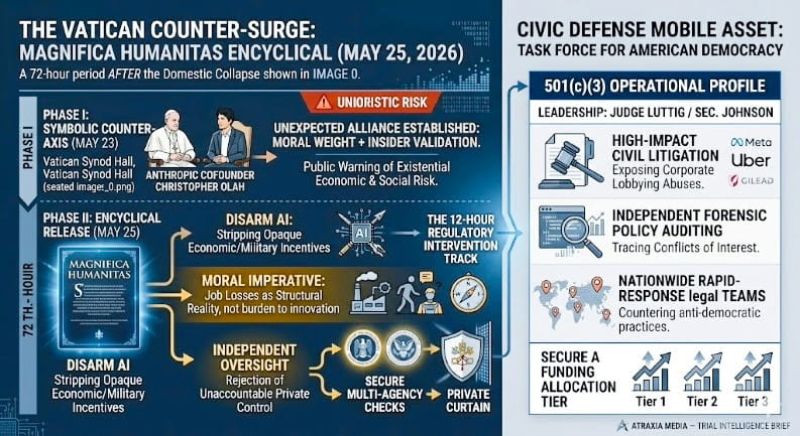
On Monday, May 25, 2026, Pope Leo XIV took direct aim at this concentrated "culture of power" by personally presenting his first landmark social encyclical, Magnifica Humanitas ("Magnificent Humanity"). In a direct rebuke to the corporate strategy of avoiding independent review, the Pontiff explicitly called to "disarm AI" by stripping it of pure military and opaque economic incentives. The text details a direct warning that leaving algorithms entirely in the hands of a small group of influential tech actors poses an immediate existential threat to social justice, fair labor, and global democratic processes.
In a historic presentation at the Vatican's Synod Hall, Pope Leo XIV shared the stage with a surprising ally: Anthropic billionaire co-founder Christopher Olah. Seated directly alongside the Pope, Olah delivered an unprecedented validation of the crisis from inside the industry itself, warning the global community that massive, destabilizing AI-driven job losses are a structural reality. Olah forcefully argued that tech development cannot be left strictly to corporate entities chasing astronomical capital valuation.
This unexpected alliance between the moral weight of the Catholic Church and an elite frontier AI creator establishes a powerful, international counter-axis to the unregulated "Wild West" model pushed by Musk, Zuckerberg, and Sacks - framing independent technical oversight not as a burden to innovation, but as a moral imperative of historic proportions.
Atraxia Strategic Action Note: Mobilizing Citizen Defense
The events of this past week expose a stark systemic vulnerability: when massive corporate blocks lose ground in courtrooms and public opinion, they bypass the system entirely to self-author the rules. To combat this concentrated distortion of our legal and democratic infrastructure, Atraxia is calling on our entire legal network to support the active defense of civic transparency.
If your firm possesses the capital and resources to fight back against this regulatory capture, we urge you to immediately get involved and support frontline democracy protection initiatives. Specifically, we stand behind the critical work of the Task Force for American Democracy, a registered 501(c)(3) public-interest organization.